
Manchester, CT · Garage Door Service
Off-Track Garage Door Repair for Farmington's 1980s Housing Stock
Farmington's housing dates mostly to 1980, later than most of the Manchester service area, with lighter steel track and roller setups that come off their hinges a specific way.
- Repairs & new doors
- Springs & openers
- Serving 6 nearby communities
The DIY Question
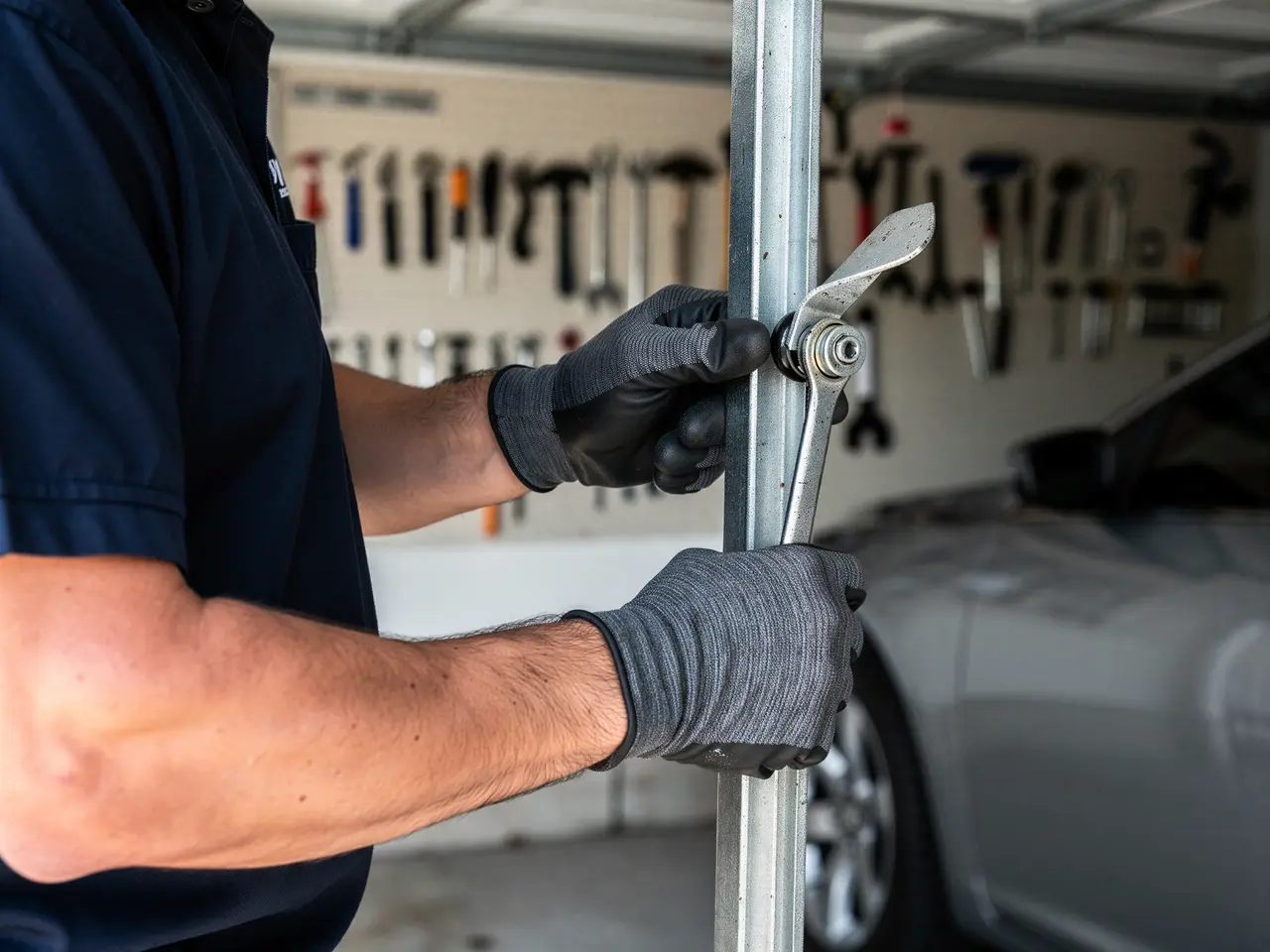
Farmington's median home was built around 1980, which puts most garages here a decade or two newer than the 1960s-70s stock that covers much of the rest of the service area. That matters because a door hanging off a roller on 1980-era steel track is usually lighter gauge than what you'd find on a house from 1965, and it flexes more before it bends permanently. Pushing a door back onto bent track yourself, or hammering the track straight with the door still loaded on it, is the single most common way a simple off-track fix turns into a track-and-hardware replacement. If the bottom roller has popped the track but the door is still square and the cables look intact, you can sometimes walk it back onto the rail by hand with the opener disconnected. If a panel is bowed, a cable has jumped its drum, or the door is cocked more than an inch out of level, that's a two-person job with a clamp, not a one-person job with a ladder. We'd rather tell you that now than bill you for the difference later.
How Long You Are Without the Door
We run out of Manchester, about 17 miles from Farmington, so there's no local branch sitting closer that can beat that drive. That distance is just the honest number - it's not a same-day guarantee and we're not going to pretend otherwise. What it does mean is that a call placed early in the day gives more room to work a Farmington stop into a route than one placed at 4pm. An off-track door is usually safe to leave shut and unopened overnight if nobody forces the opener - the bigger risk isn't the wait, it's someone trying to run the opener against a door that's already off its track, which can tear the section away from the hardware entirely.
Why This Fails Locally
Houses going up around Farmington in the late 1970s and into the 1980s mostly got steel sectional doors on roll-formed track with nylon or steel rollers - lighter and cheaper to install than the heavier tracks used a decade earlier, and more prone to flare at the curve if a bottom bracket works loose over time. Households here report a median income of $134,237, well above the $104,976 median across the wider area, which tends to mean owners replace openers and springs proactively rather than running them to failure - but the track and roller hardware itself rarely gets touched until something actually derails. The climate band for this part of Connecticut is classified cold and severe, and repeated freeze-thaw cycles work on track fasteners the same way they work on fence posts: a few winters of expansion and contraction and a bracket that was snug is now loose enough to let the door walk sideways off the rail under normal use.
What Can Go Wrong
On 1980-era track, the most common off-track cause is a bottom roller bracket that's worked its lag screws loose from the jamb - the door looks fine until someone closes it hard and the bottom corner walks off the rail. Second most common: a cable that's frayed at the drum and jumped off, which pulls one side of the door down unevenly and forces the opposite roller out of its track. Less common but more expensive: a section that's cracked at the hinge stile and lets the whole panel twist, which bends the track on its way out rather than just popping loose from it. Bent track from any of these can sometimes be reset with a level and clamps if it's caught early; once it's kinked at the curve near the header, replacing that section of track is usually faster and cheaper than trying to straighten it back to true.
What You Are Seeing
If you're standing in the garage right now, here's roughly what tells you which problem you have. A door that's stuck a few inches up, cocked to one side, with a visible gap between the roller and the rail on one side only, is almost always a bracket or roller problem - straightforward. A door that dropped suddenly on one corner, with a loose cable hanging slack, is a cable-off-the-drum issue, and that one's not safe to force with the opener. A door that looks bowed or twisted along its width, not just tilted, points to a cracked section rather than a track problem, and no amount of track adjustment fixes that - it's a replacement panel. With roughly 10,963 households in Farmington and most garages built to the same late-1970s/early-1980s spec, these three patterns cover nearly everything we see out this way.
Frequently asked questions
Is it safe to drive my car out if the garage door is off its track?
Only if the door is stuck in the open position and isn't blocking the opening - do not try to force it down or up with the opener. If it's stuck partway, treat it as blocked and find another way out; forcing a door that's off-track against the opener chain can tear the section loose from the track entirely.
Why does my 1980s-era door come off track more than a newer one would?
Steel sectional doors from that period typically used lighter-gauge roll-formed track than current builds, and after decades of cold-weather expansion and contraction, bracket screws work loose at the jamb. That loosening is what lets a roller walk off the rail under normal use rather than something catastrophic happening.
Do you have a crew based in Farmington?
No - we run out of Manchester, about 17 miles away, and travel in for jobs. There's no local depot or faster response guarantee for Farmington specifically; the drive is simply part of the job.
Can a bent track always be straightened instead of replaced?
Sometimes, if it's caught before the bend reaches the curved section near the header. Once the curve itself is kinked, straightening rarely holds and replacing that section of track is usually the more reliable and often cheaper fix.
More garage door services in Farmington
Book garage door service in Manchester
Call now or request a quote - tell us what the door is doing and where you are.