
Manchester, CT · Garage Door Service
Why Openers and Power Outages Hit Manchester Homes Differently
Manchester's housing stock dates mostly to the 1960s and 70s, paired with a severe cold climate - a combination that strains openers and leaves doors stuck when the power drops.
- Repairs & new doors
- Springs & openers
- Serving 6 nearby communities
What Local Conditions Do
Most houses in Manchester went up between 1938 and 1990, with the bulk of that stock dating to the 1960s and 70s. That matters more than it sounds like it should, because the garage door opener on a house built in 1968 was almost never designed with a battery backup in mind - that feature is a newer addition to the market, and retrofitting it is a separate job, not something that came with the house.
Layer on the climate. This area sits in a cold-severe band, which means winters bring sustained stretches below freezing, not just the occasional cold night. An unheated attached garage in a house from that era stays close to outdoor temperature for days at a time. Steel springs stiffen, chain-drive openers strain a little harder to pull a door that's heavier to move when its hardware is cold, and standby batteries in any backup unit that has been added lose capacity faster in the cold than their rating sheet suggests.
None of this is dramatic on its own. It's the combination - older opener hardware, an unheated bay, and a winter that doesn't let up - that turns a minor issue into a door that won't open the one morning you need it to.
What Is Going On
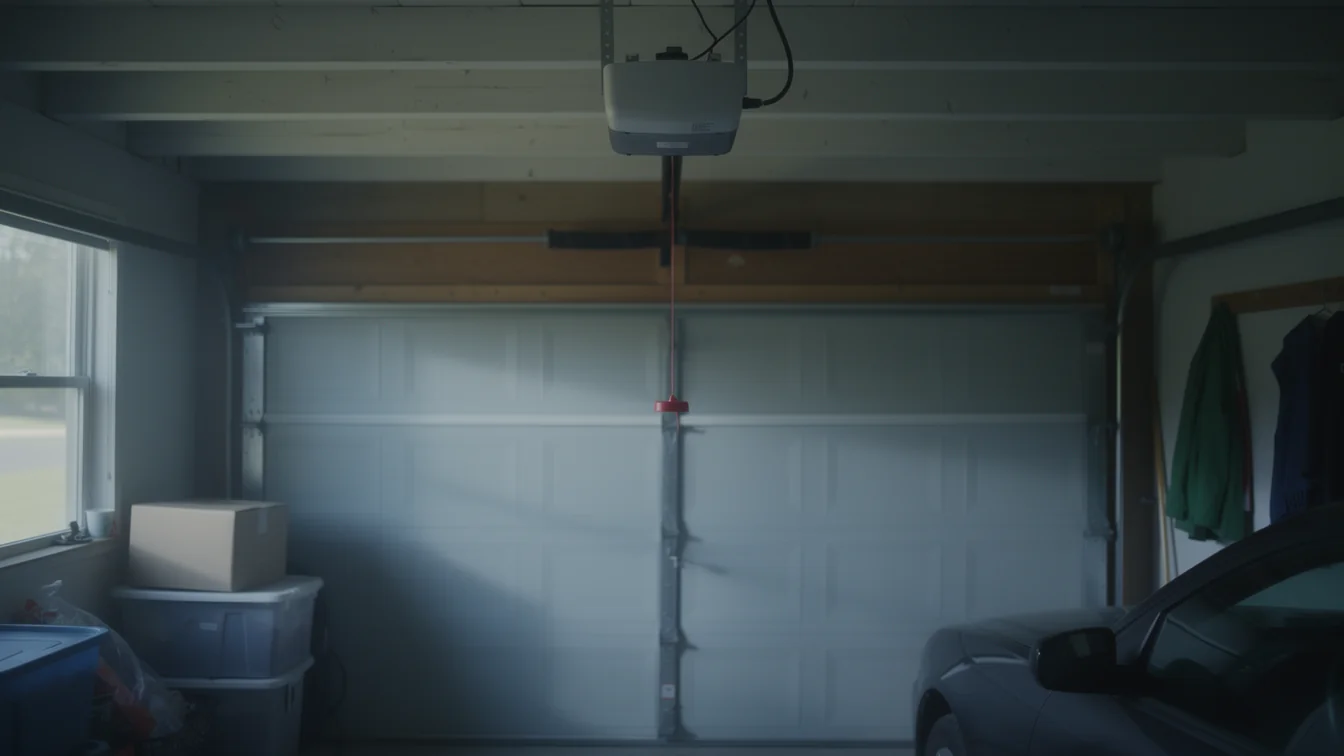
When the power goes out, a chain or belt opener with no backup battery simply stops. The motor has no way to run, and most homeowners don't know where the manual release cord is until they need it - or they pull it without realizing the door is still under spring tension and can drop faster than expected.
In a house from the 1960s or 70s, there's also a decent chance the opener itself has been swapped once or twice since the house was built, but the wiring and the outlet it plugs into often haven't. A single dedicated circuit built for a smaller load, in an unheated space, in a cold-severe climate, is a setup that works fine for years and then doesn't - usually on the coldest week of the year, which is exactly when you'd most want the door to work without a fight.
We don't have local storm or outage frequency data to point to here, so we're not going to tell you how often this happens in Manchester specifically. What we can tell you is what the housing stock and the climate band mean for the hardware sitting in your garage right now.
Doing Nothing For Now
If your opener is original to a 1960s or 70s build and it's still running - lifts smoothly, doesn't strain, reverses when it should - there's no case for replacing it just because it's old. A working motor is a working motor. Spend money where something is actually failing, not on a calendar date.
The honest limitation here: we don't carry every part for every opener model from that era, and some of them are long out of production. If a specific gear or circuit board has failed on a decades-old unit, sourcing an exact replacement part can take longer than most people expect, and sometimes it isn't available at all. At that point the choice isn't between fixing it fast or fixing it slow - it's between a new opener and an open-ended wait.
So the move, if your door works, is to let it keep working. Know where the manual release is before winter, not during an outage. That's a five-minute check, not a repair.
The Common Mistake
The mistake we see most is someone forcing a manual release during a power outage without first supporting the door. On a door that's properly balanced, pulling the release cord and lowering it by hand is fine. On a door with springs that have drifted out of adjustment - common enough on hardware that's been in a cold garage for fifty-plus years - the door can drop hard and fast the moment it's disconnected from the opener, because the opener had been quietly doing some of the spring's job for longer than anyone realized.
The second version of this mistake is treating a battery backup as something every house already has. In a service area built mostly between 1938 and 1990, that's not a safe assumption. If you've never checked whether your opener has one, the answer is probably no, and that's worth knowing before the power goes out rather than during.
Frequently asked questions
Do older openers in Manchester need a battery backup added?
Not automatically, but it's worth knowing you probably don't have one. Houses here mostly date to the 1960s and 70s, built long before battery backup was standard on openers. If losing access to the garage during an outage would be a real problem for you, adding backup is a retrofit, not something to assume came with the house.
Why does my garage door feel heavier to open in winter?
This area sits in a cold-severe climate band, and an unheated garage attached to an older house stays near outdoor temperature for days. Cold stiffens springs and thickens old lubricant on tracks and rollers, which makes the door feel heavier than it does in summer even when nothing is actually broken.
Should I replace my opener just because it's decades old?
No - if it still lifts smoothly and reverses correctly, age alone isn't a reason to replace it. The time to act is when a part actually fails, not on a schedule. The catch is that parts for some older models are slow to source or no longer made, so a failure can mean a longer wait than you'd expect.
Related garage door services in Manchester
More garage door guides
Book garage door service in Manchester
Call now or request a quote - tell us what the door is doing and where you are.