Manchester, CT · Garage Door Service
Cable Repair for Farmington's Newer Garage Doors
Farmington homes built after 1980 mostly run torsion cable on steel sectional doors, not the older extension springs seen closer to Manchester. Here's what breaks and why.
- Repairs & new doors
- Springs & openers
- Serving 6 nearby communities
The DIY Question
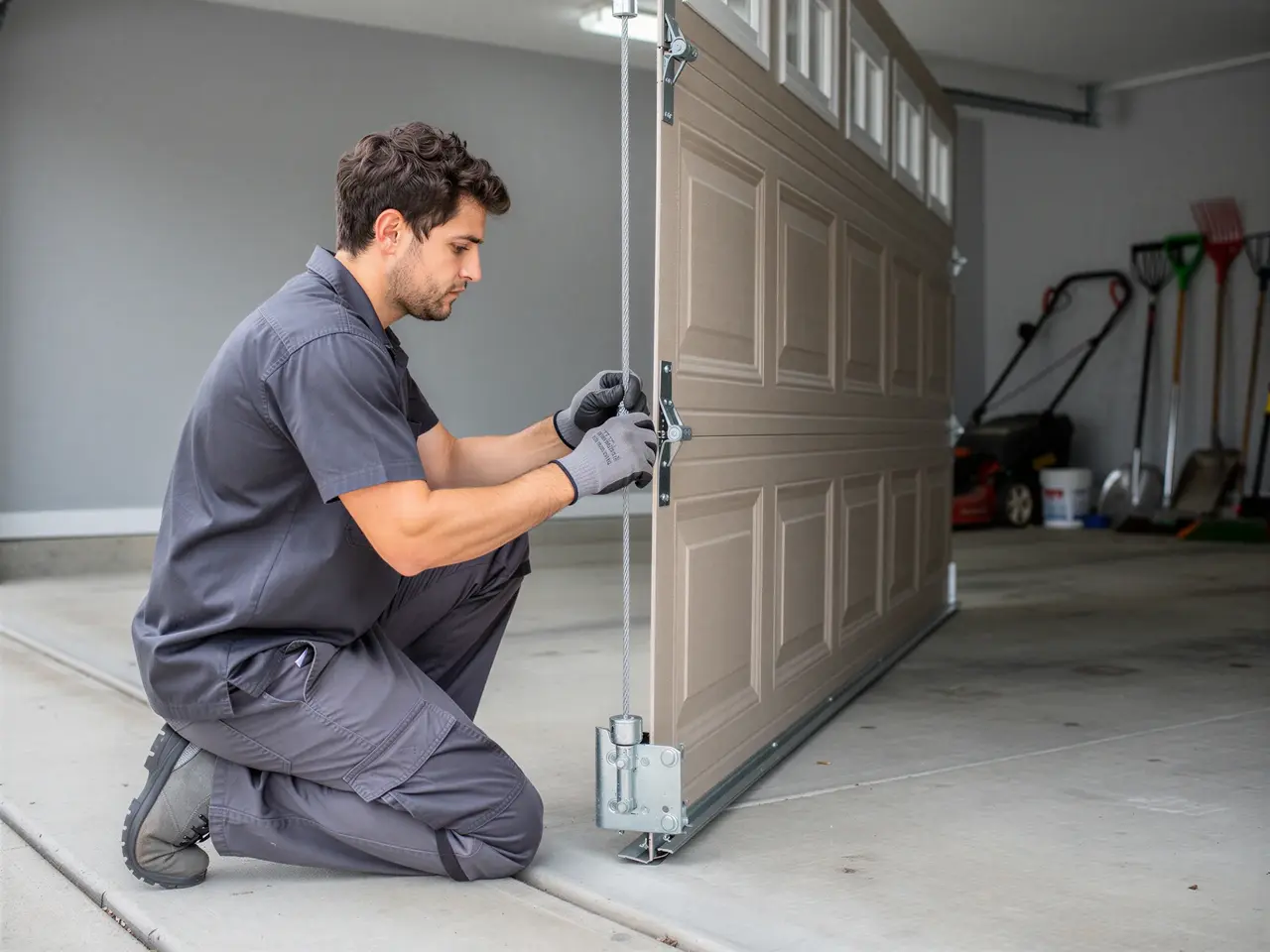
Most of Farmington went up after 1980, a good decade later than the 1972 median across the wider service area, which means you're mostly looking at steel sectional doors on torsion cable rather than the older extension-spring setups still common on 1960s houses closer to Manchester. That matters for the DIY question, because a torsion cable is wound under real tension by a spring that stores enough force to break a finger or worse if it lets go while you're working on it.
A cable that's slipped off the bottom bracket, with the door still sitting level, is about as far as a careful homeowner should go - and even then, only with the opener unplugged and the door blocked. A frayed or snapped cable on a loaded torsion spring is not a job to learn on your own garage. If the door is crooked, stuck, or one corner is dropped lower than the other, stop and call rather than reach for a ladder.
We'll be straight about it: we don't walk people through cable replacement over the phone, and we won't sell you a cable kit over the counter for a torsion system. The risk isn't worth what you'd save.
How Long You Are Without the Door
Farmington sits about 17 miles out from Manchester, one of the farther stops we make in the service area, so the truck isn't idling around the corner. We don't quote a fixed response window here because we haven't tracked one specific to this stretch of road, and we'd rather tell you that than guess.
What we can tell you: a door with a snapped cable doesn't get safer by waiting, especially if the spring is still under tension and the door is sitting crooked in the opening. If it's a two-car door, you're looking at a heavier panel assembly than the single-car doors common in older, smaller-lot neighborhoods, and a heavier door under uneven cable tension puts more strain on the remaining hardware.
One honest limitation: if your cable length or drum size is a less common spec, we may not have the exact match on the truck the first visit. With roughly 10,963 households in this pocket and houses mostly from a narrow build era, parts tend to be consistent - but we won't promise a one-trip fix before we've seen the hardware.
Why This Fails Locally
Cable failure here tends to follow the hardware that came with houses built around 1980, not the hardware you'd find on an older door. Builders in that era mostly ran galvanized aircraft cable off a torsion drum rather than the lighter cable-and-pulley extension setups used on earlier sectional doors. That cable is more durable day to day, but when it does fail, it tends to fail at the drum end, where the strands wrap and re-wrap thousands of times over four decades.
Winters in this part of Connecticut sit in the severe end of the cold band, and cold stiffens the lubricant on a drum and track, which makes a marginal, slightly frayed cable more likely to let go on a frigid morning than on a mild one. A cable that's been quietly losing strands all fall tends to announce itself the first hard freeze.
Median income in this pocket runs $134,237, well above the $104,976 median across the wider service area, and that often tracks with doors that were a notch up in spec when built - heavier panels, wider spans - which puts more load on the same cable than a narrower single-car door would.
What Can Go Wrong
A cable can come off the drum without breaking, usually from a bent track or a roller that's binding - the door will look fine at rest but jam or run crooked when you try to move it. That's a different fix than a snapped cable, and sometimes a cheaper one.
A fully snapped cable is more serious, especially on a double door from the 1980s build era, because those doors are wide enough that a single failed cable lets one side of the door drop while the other stays up, racking the panels against the track. Keep running the opener in that state and you can bend the track or crack a panel seam, turning a cable job into a track-and-panel job.
On torsion systems, a cable failure can also mean the spring itself has been cycling unevenly for a while, which shortens its life even if it hasn't broken yet. We check both when we're out, because replacing a cable and leaving a spring that's about to go is a callback waiting to happen. We don't replace springs we haven't inspected - that's a separate quote, not a bundled guess.
What You Are Seeing
The most common sign is a door that's noticeably off-level - one bottom corner sits an inch or two lower than the other, or the whole door tilts when it's partway open. Look at the bottom corners of the door near the brackets: a cable with visible frayed strands, or one that's gone slack and loose while the other side stays taut, is a clear tell.
Sometimes it's a sound rather than a sight - a snap or a loud pop from the garage, followed by the door refusing to open or closing unevenly. If the opener is straining, clicking, or reversing on its own when you try to run the door, don't keep cycling it; that's often the drum or cable catching on something it shouldn't.
On a steel sectional door typical of this area's 1980s-era builds, a cable issue sometimes shows up first as a scraping sound along the track rather than anything visibly wrong with the cable itself, because the door is riding slightly off its intended line before the cable actually lets go.
Frequently asked questions
Is it safe to replace a garage door cable myself in Farmington?
Not if it's a torsion cable, which is what most doors built here since 1980 use. The spring holds real stored tension, and a cable failing under that load can snap back hard. If the door is crooked or a cable looks frayed, leave it alone and call rather than open it with the opener.
Why did my cable snap now and not last winter?
Cable wear is gradual - strands fray a little each cycle, and cold weather stiffens lubricant and makes a weakened strand more likely to let go. A cable that survived mild winters can fail the first hard freeze once it's lost enough strands.
Do you carry the right cable for my door on the first visit?
Usually, since most houses in this area share a similar build era and hardware spec, but not always. If your drum size or cable length is uncommon, we may need a return visit rather than guess at a fix on the spot.
Can I just use the door on one cable until you get here?
No. Running the door with one cable snapped lets the panel rack against the track, which can bend the track or crack a panel - turning a cable repair into a bigger job. Leave the door closed and don't cycle the opener until it's looked at.
More garage door services in Farmington
Book garage door service in Manchester
Call now or request a quote - tell us what the door is doing and where you are.