
Manchester, CT · Garage Door Service
Garage Door Service for Farmington Homes Built Around 1980
Farmington's housing dates mostly to 1980, later than most of the service area. Here's what that means for springs, openers, and what actually breaks first.
- Repairs & new doors
- Springs & openers
- Serving 6 nearby communities
The DIY Question
The honest answer depends on what year your door went in, and in Farmington that's usually around 1980 - later than a lot of the housing stock closer to Manchester, which runs as old as 1938. That matters because 1980 lands right at the edge of the extension-spring era. If your door is original, you're more likely dealing with early torsion hardware than the exposed stretch springs still common on older houses in this service area.
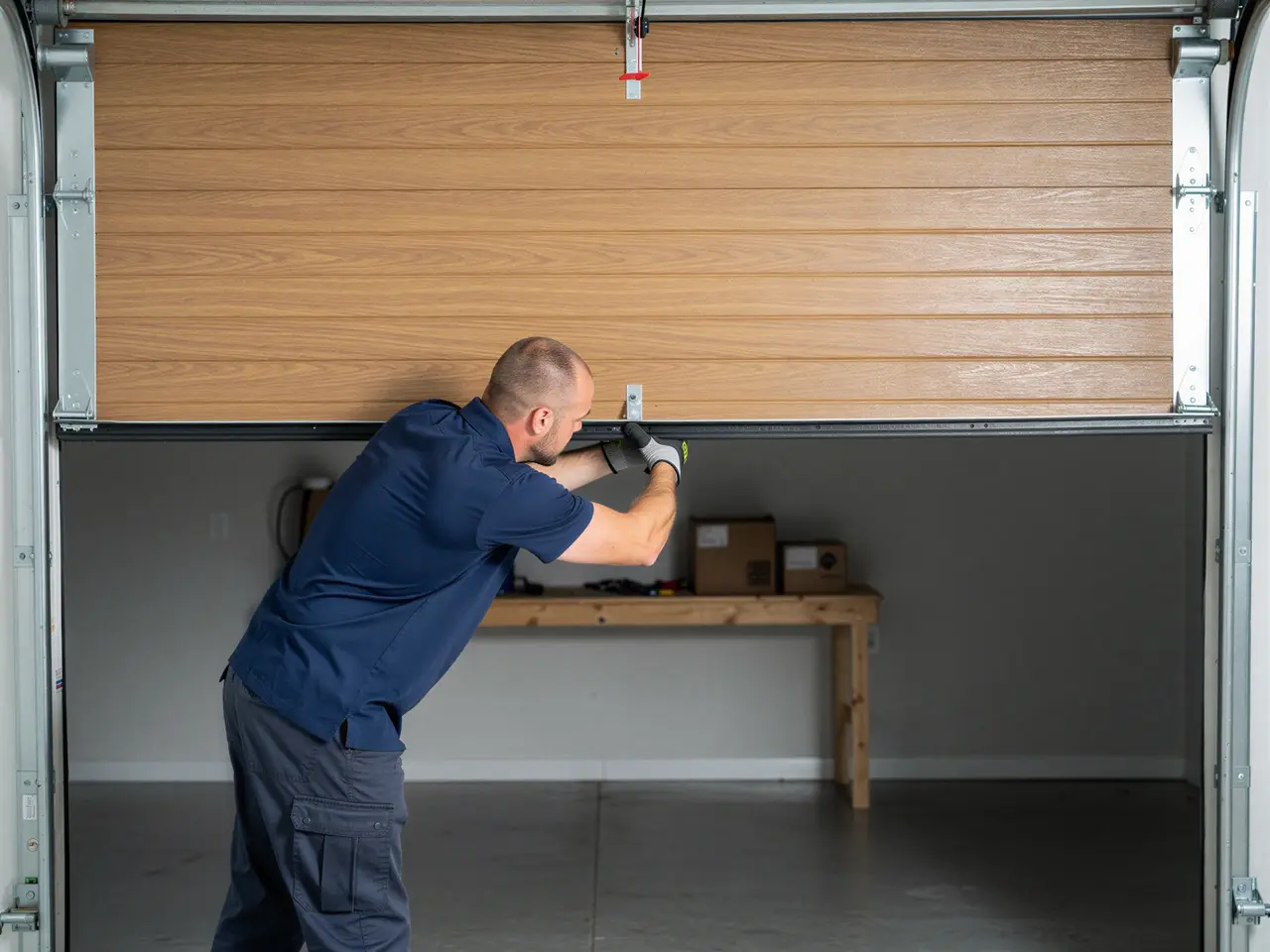
A torsion spring under tension is not a safe DIY repair - full stop. Swapping a roller, lubricating a track, or tightening a loose bracket bolt, fine, a homeowner can do that with basic tools. Winding or unwinding a torsion spring with the wrong bars, or guessing at the cable routing, is how people end up in the ER. If you're not sure which spring type you have, that's reason enough to call rather than open the door panel and start pulling cables.
We'll say plainly: if your opener is original to a 1980 build, it's near the end of its working life either way, and sometimes a repair isn't worth doing twice.
How Long You Are Without the Door
We run this route from Manchester, about 17 miles out, which is farther than most of the towns on our list. We're not going to promise a response window here that we can't back up - that's not honesty, it's marketing, and we don't do it.
What we can tell you is what drives the wait on our end: whether the part is one we carry on the truck, or one we have to source for a torsion system that's original to a 1980-era build. Rollers, cables, and common spring sizes are usually on hand. A specific opener board for a unit that old sometimes isn't, and if it's a discontinued model, we're ordering it same as you could.
The distance itself isn't the bottleneck most days - it's parts availability for hardware that's 40-plus years into its service life. That's worth knowing before you're standing in the driveway waiting.
Why This Fails Locally
This region sits in a cold climate band, and the cold doesn't care how old your door is - it changes how steel behaves either way. But the timing of the failure does depend on the hardware generation, and Farmington's is mostly 1980-vintage.
A torsion spring loses a measurable amount of lift tension as temperatures drop. On a spring that's already 40-plus years old and was never oversized to begin with, that loss is enough to tip a door from 'a little heavy' to 'won't stay up.' That first hard freeze is often the moment a spring that's been slowly weakening finally lets go, rather than a sudden random failure.
Openers from this era read the strain differently too - older circuit boards don't always sense a bound-up door the way a modern unit does, so instead of stopping, the motor keeps pulling against resistance until a gear strips or a capacitor goes. That's a pattern we see tied to build year, not bad luck.
What Can Go Wrong
On a door from around 1980, the short list looks like this: the torsion spring itself, now well past the point most manufacturers rate for cycle life; the cable drums, which corrode from the inside out on steel that's been through forty-some winters; and the opener, if it's original, where the drive gear is plastic and the motor capacitor is well past its rated life.
Rollers are usually steel on builds this old, not nylon, and they're noisy and slow to wear the track edges unevenly over decades - that shows up as a door that rattles more on one side than the other.
We don't see much rot or warping in panel material at this build date - steel doors from 1980 hold up fine structurally. The failures are mechanical: spring, cable, drum, opener. That's a narrower list than a house with original 1940s or 1950s wood hardware, and it's part of why the fix is usually more predictable here than it is closer to Manchester.
What You Are Seeing
If your door is from the original 1980-era build, the signs usually show up gradually, not all at once. The door feels heavier than it used to when you lift it by hand with the opener disconnected - that's spring tension fading, not the door getting heavier. It drifts down a few inches after the opener stops, or it reverses partway up for no clear reason, which often points to the opener misreading resistance from stiff, aging cable drums.
You might hear a grinding or popping sound from one top corner - that's usually a cable drum starting to wear unevenly rather than the spring itself. A door that closes unevenly, with one side reaching the floor before the other, points the same direction.
None of these are emergencies by themselves, but they're the early stage of the spring or cable failure that this build era is due for. Catching it at the noise-and-drift stage is cheaper than catching it when the spring actually breaks.
Frequently asked questions
Is a 1980 garage door too old to repair, or should I just replace it?
Depends what's failing. A worn spring, cable, or opener motor on an otherwise sound steel door is usually worth repairing. If the track is bent, the panels are dented and misaligned, or you're replacing the third part in two years, replacement is the better math. We'll tell you which one you're looking at rather than default to the bigger job.
Do you have a branch in Farmington?
No. We run out of Manchester and cover Farmington as part of the service area, about 17 miles out. That doesn't change the work once we're there, but we're not going to claim a local response time we can't guarantee.
Why does my door feel heavier in winter?
Cold steel contracts and torsion springs lose a measurable amount of lift tension as temperatures drop. On a spring that's already decades old, that loss is often what finally tips a slow decline into a door that won't stay up - the cold doesn't cause the wear, it exposes it.
More garage door services in Farmington
Book garage door service in Manchester
Call now or request a quote - tell us what the door is doing and where you are.