
Manchester, CT · Garage Door Service
Cable Repair for Tolland's 1980s Garage Doors
Cable repair for Tolland's 1980-era doors, serviced from Manchester 11 miles away. Right-sized cable and drum parts for the extension-spring hardware common on this town's housing stock.
- Repairs & new doors
- Springs & openers
- Serving 6 nearby communities
Booking a Visit
We run this job out of Manchester, about 11 miles from Tolland, so there's no local branch to swing by and no walk-in counter. A call gets a truck routed out to you, but we're not going to pretend we're already around the corner - we're not. What that distance does mean is we try to get the diagnosis right over the phone first: what the door is doing, whether it's one cable or two, whether the drum came off the shaft. That saves a second trip once we're out there, which matters more on a town this far from the shop than it would somewhere closer in.
Tolland's households skew toward higher income than much of the rest of our area - median household income here runs around $132,500 - but that doesn't change what the repair costs or how fast parts move. It just means we're not guessing at what a homeowner here is willing to spend on doing the job right the first time instead of patching it twice.
Parts We Carry
Tolland's housing stock centers on 1980, newer than a lot of the towns we cover, and that build year matters for cable work. Doors from around then typically run extension springs on each side of the track rather than a single torsion shaft, with galvanized aircraft cable looping down to a drum or pulley at the bottom bracket. We carry replacement cable sized for that setup - not the same gauge or length you'd need on a 1960s torsion door, which is what a lot of our stock is built around given the service area's overall median year of 1972.
We also carry the drums and bottom brackets that cable failures tend to take out with them, since a snapped cable on an extension-spring door often chews up the pulley or bends the bracket on its way down. What we don't stock on the truck is every obscure drum size from a door that's been modified or replaced piecemeal over 40-plus years - if your setup has been retrofitted, there may be a short wait on an exact match.
What Can Go Wrong
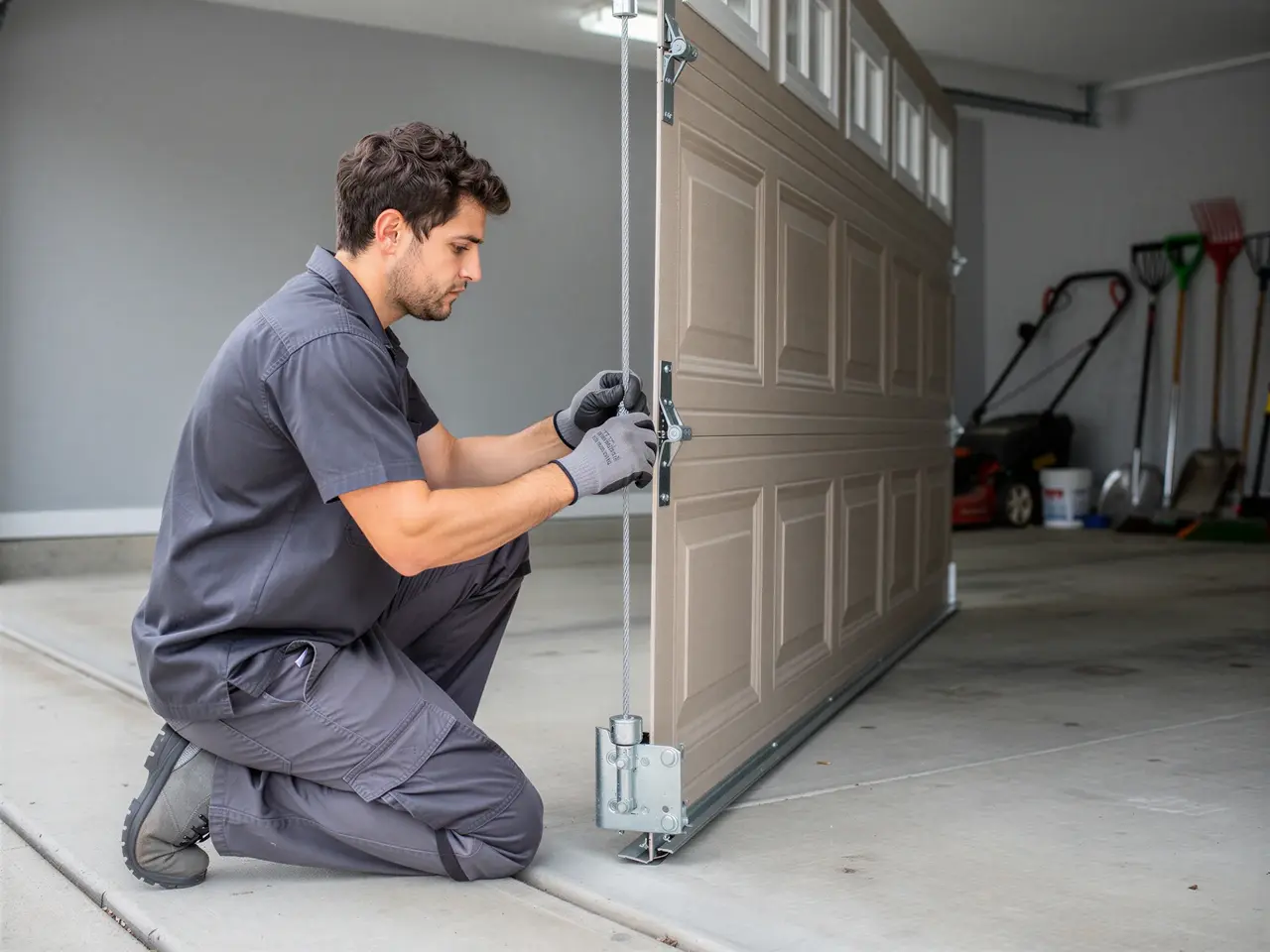
On extension-spring doors from the 1980-ish era common in Tolland, the cable usually fails one of two ways: it frays where it wraps the drum from years of cycling, or it jumps the track groove and gets crushed between the drum and the bracket. Either way the door comes down crooked - one side drops faster than the other because only one cable let go.
Cold matters here too. This area sits in a severe cold climate band, and cable that's already worn thin gets brittle and snaps outright on the first hard cold snap of the season rather than fraying slowly. We see more cable calls in the first real cold stretch than any other time of year, which tracks with how the material behaves, not bad luck.
The other failure mode is a cable that's intact but has simply come off the drum - no snap, just a door that won't move right because the cable is unspooled or wound wrong. That one's a re-spool job, not a replacement, and it's worth telling apart from an actual broken cable before anyone starts ordering parts.
How Long You Are Without the Door
If it's a straightforward snapped cable and we've got the right gauge on the truck, the door is back in service the same visit - this isn't a part we typically have to special-order for a standard 1980s extension-spring setup. Where it stretches out is if the drum or bracket got bent badly enough in the failure that we need a replacement piece that isn't a universal fit, which happens more often on doors that have had other work done to them over the decades.
Either way, a door with one cable broken shouldn't be opened and closed on the remaining cable and spring - that's how you bend a track or crack a panel, and then you've turned a cable call into a bigger one. Leave it down, or leave it up and don't touch the opener, until the second cable is addressed too, even if it looks fine. Cables on the same door are usually close in age and wear.
The DIY Question
We'll say it straight: don't do extension spring cable work yourself. The spring is under load even with the door down, and the cable runs right past where your hands and face end up if something slips. A broken cable is one of the few garage door failures that's genuinely dangerous to work on without the right clamps and bar, not just inconvenient.
Where a homeowner can actually help themselves is in diagnosis before the call - knowing whether the door dropped on one side or both, whether you can see a cable hanging loose versus wound but off-track, and roughly how old the door is. On a town with housing mostly dating to 1980, most of these doors are old enough that original hardware is near the end of its working life anyway, so sometimes the honest answer on a repair call is that the cable isn't the only thing close to failing, and it's worth asking us about that instead of just swapping the one part.
What You Are Seeing
The clearest sign is a door that's visibly tilted - one bottom corner sitting lower than the other, or the whole panel jammed at an angle in the track. That's a cable gone on one side. If both cables let go at once, which is rarer, the door drops hard and sits flush but won't lift at all.
A looser sign is a door that runs rough, makes a scraping or grinding noise low down near the bottom bracket, or visibly shows frayed strands near the drum - a cable in that state hasn't failed yet but it will, often on the next cold morning. On a door built around the 1980 era common across Tolland, loose coils of cable sitting unspooled on the floor of the track is also something we hear about, which usually points to the cable coming off the drum rather than snapping outright.
Frequently asked questions
Why does my garage door sag on one side only?
That almost always means one of the two lift cables has broken or come off its drum while the other is still holding. The side with the failed cable drops because nothing's pulling it up anymore. Don't force the opener - stop using it until both cables are checked, since running it crooked can bend the track or crack a panel.
Is cable repair different for an older vs newer garage door?
Yes. Tolland's housing mostly dates to around 1980, which typically means extension springs and cable sized for that hardware. Older stock elsewhere in our area, closer to 1960s-70s, often runs torsion springs instead, which use a different cable length and drum setup entirely.
Can I replace a broken garage door cable myself?
We don't recommend it. Extension springs stay under tension even with the door closed, and the cable runs close to where your hands go during the fix. It's one of the few garage door repairs where the injury risk outweighs the money saved doing it yourself.
How fast will a broken cable fail completely in cold weather?
This area sits in a severe cold climate band, and cable that's already frayed tends to snap outright during a hard cold snap rather than wearing through slowly. If you notice fraying near the drum in fall, it's worth getting it swapped before winter rather than waiting for it to fail.
Book garage door service in Manchester
Call now or request a quote - tell us what the door is doing and where you are.