
Manchester, CT · Garage Door Service
Knowing When a Manchester Garage Door Is Done For
Manchester homes built mostly 1938-1990 carry original doors that take a beating in Connecticut's cold winters. Here's how to tell a repair from a replacement job.
- Repairs & new doors
- Springs & openers
- Serving 6 nearby communities
What Local Conditions Do
Manchester sits in a cold climate band with severe winter conditions, and that matters more for a garage door than most homeowners realize. Torsion springs lose tension faster when they cycle through hard freezes and thaws over and over. Weatherstripping along the bottom panel cracks and shrinks in the cold, letting in wind and road salt spray. Steel tracks pick up rust where snowmelt runs off the roofline and pools near the slab. None of this is dramatic on its own, but it adds up over decades, and most of the doors in this area have had plenty of decades to take the hit. A door that still opens fine in October can bind or drop unevenly by February once the cold sets into the hardware. If your rollers are original and your spring has never been swapped, Manchester winters are the reason the wear shows up where it does - at the bottom corners, along the track seams, and in the spring cone itself. That's the baseline you're working against here, not a generic maintenance checklist that would read the same in a warmer state.
What Is Going On
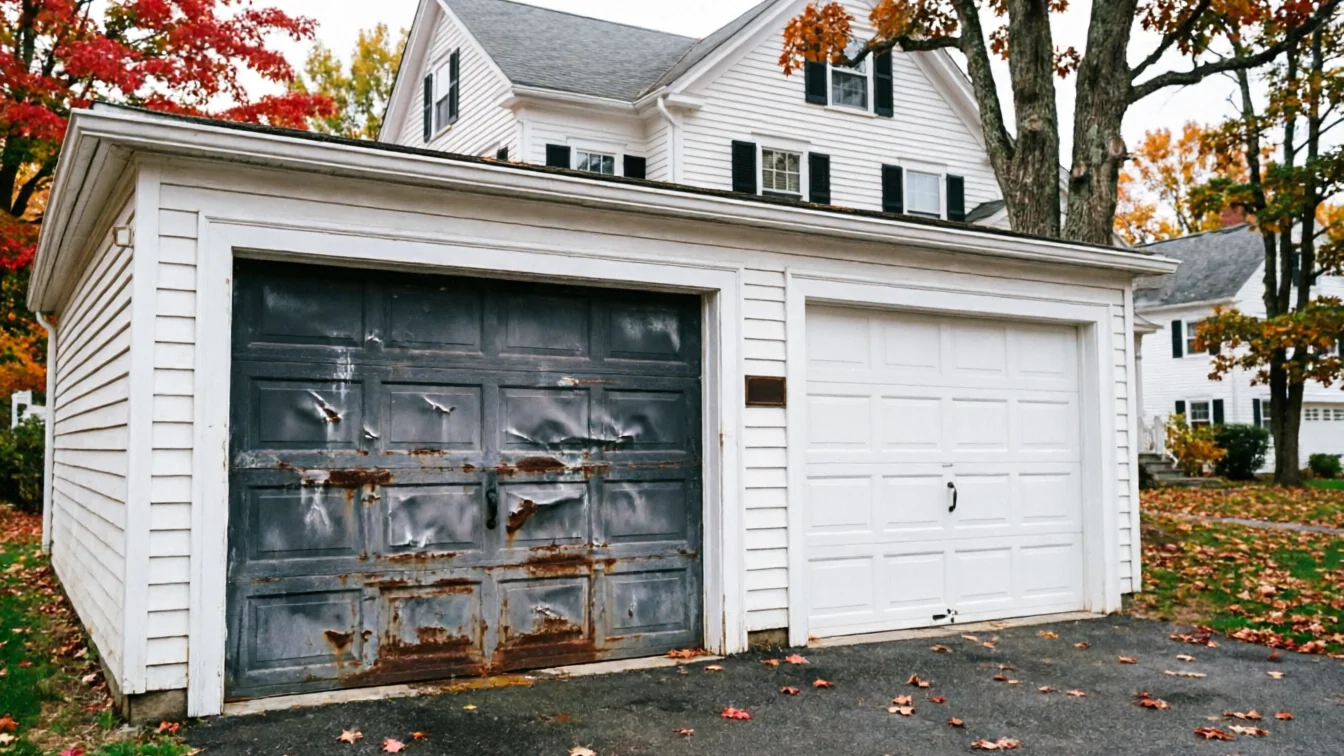
Housing in and around Manchester mostly went up between 1938 and 1990, with the median build year landing at 1972. That puts a large share of the area's garage doors squarely in the 1960s and 70s cohort - old steel sections, older openers, and in some cases hardware that was never upgraded when the rest of the house got remodeled. A door from that era was built to a different standard than what's sold today, with thinner panel steel and springs rated for a shorter cycle life. When one of these doors starts acting up - a spring that's lost tension, a track that's pulled slightly out of plumb, an opener that grinds on start-up - you're not dealing with a fluke. You're dealing with a 50-plus-year-old system reaching the end of what it was built for. The call we get most often from these houses isn't "my door won't open," it's a vague complaint about noise or slow travel that, once we're looking at it, turns out to be a spring and a set of rollers that are original to the house. That's the pattern across this stock, not an isolated case.
Doing Nothing For Now
Sometimes the right move really is to wait. A door that's noisy but still opens and closes evenly, with a spring that still has tension and a track that's not bent, doesn't need to become a job this week. If the opener is original to a 1970s build and still runs the door smoothly, replacing it early just because of its age isn't worth the money. We'd rather lubricate the hardware, check the cable condition, and tell you honestly that it's good for another season than sell you a job you don't need yet. The thing we watch for is a change in behavior, not the calendar. A door that starts reversing partway up, or a spring that visibly sags when the door's down, is telling you something specific. One that just squeaks has usually got a maintenance fix, not a replacement one. The honest limitation here: once a part for an older opener model is genuinely discontinued, we can't promise we can source it, and at that point waiting only delays a decision you were always going to have to make.
The Common Mistake
The mistake we see most in this area is replacing one component - usually the opener, sometimes just the spring - on a door whose panels and track are already near the end of their service life, and expecting that to solve the problem for good. With a median household income of $104,976 across the service area, a lot of homeowners can afford to do the job right the first time, but plenty still opt for the cheapest fix because the door is "basically fine." On a 1960s or 70s door with rusted track and brittle panel steel, a new opener on old hardware just shifts the strain somewhere else, and you're back out here within a year or two for the next failure. The better call, once a door is carrying multiple age-related problems at once, is to replace the whole system rather than patch it piece by piece. That's a harder conversation than selling a single repair, but it's the one that actually saves money for houses built in this window.
Frequently asked questions
How old does a garage door have to be before repair stops making sense?
Age by itself isn't the deciding factor - condition is. A door from the 1960s or 70s with one failed part and otherwise sound track and panels is usually worth repairing. Once you're dealing with rusted track, brittle panels, and an aging spring all at the same time, replacement typically costs less over time than chasing each failure separately.
Why does my garage door act up more in winter here?
Manchester sits in a cold climate band with severe winter conditions, and that stresses torsion springs, weatherstripping, and track alignment more than warmer weather would. Original hardware from the 1960s-70s building boom in this area wasn't built with today's cold-tolerant materials, so the wear shows up fastest on older doors during the coldest months.
Can you still get parts for a garage door from the 1970s?
Sometimes, but not always. Original springs and rollers are usually straightforward to match. Opener parts from that era are a different story - once a model is discontinued, we can't source every component, and that's when replacement becomes the only real option rather than a preference.
Related garage door services in Manchester
More garage door guides
Book garage door service in Manchester
Call now or request a quote - tell us what the door is doing and where you are.