
Manchester, CT · Garage Door Service
Why a Door Goes Off Track Around Manchester
Manchester's 1960s-70s housing stock and cold winters push doors off track in predictable ways. Here's what's actually happening and when to call it in.
- Repairs & new doors
- Springs & openers
- Serving 6 nearby communities
What Local Conditions Do
Most houses in this part of Manchester, from Buckley and Highland Park down to Keeney and Spencer, were built between 1938 and 1990, with the bulk going up in the 1960s and 70s. That median build year of 1972 matters for track problems specifically: the tracks on doors from that era were hung with lighter steel brackets than what gets installed today, and fifty-plus years of freeze-thaw cycles on the house framing shifts the jamb just enough that a track bolted tight in 1971 is no longer plumb. Add in a cold-climate winter - real cold, not mild - and the slab under the track heaves a fraction of an inch some years and settles back the next. The track doesn't move on its own. The house around it does, a little, every season, and the track is bolted to that house. A door that rolls fine in August and binds in January isn't failing - it's following the building. That's the pattern across the older stock here, and it's different from what you'd see in a subdivision built on a slab poured in the last fifteen years with modern anchors.
What Is Going On
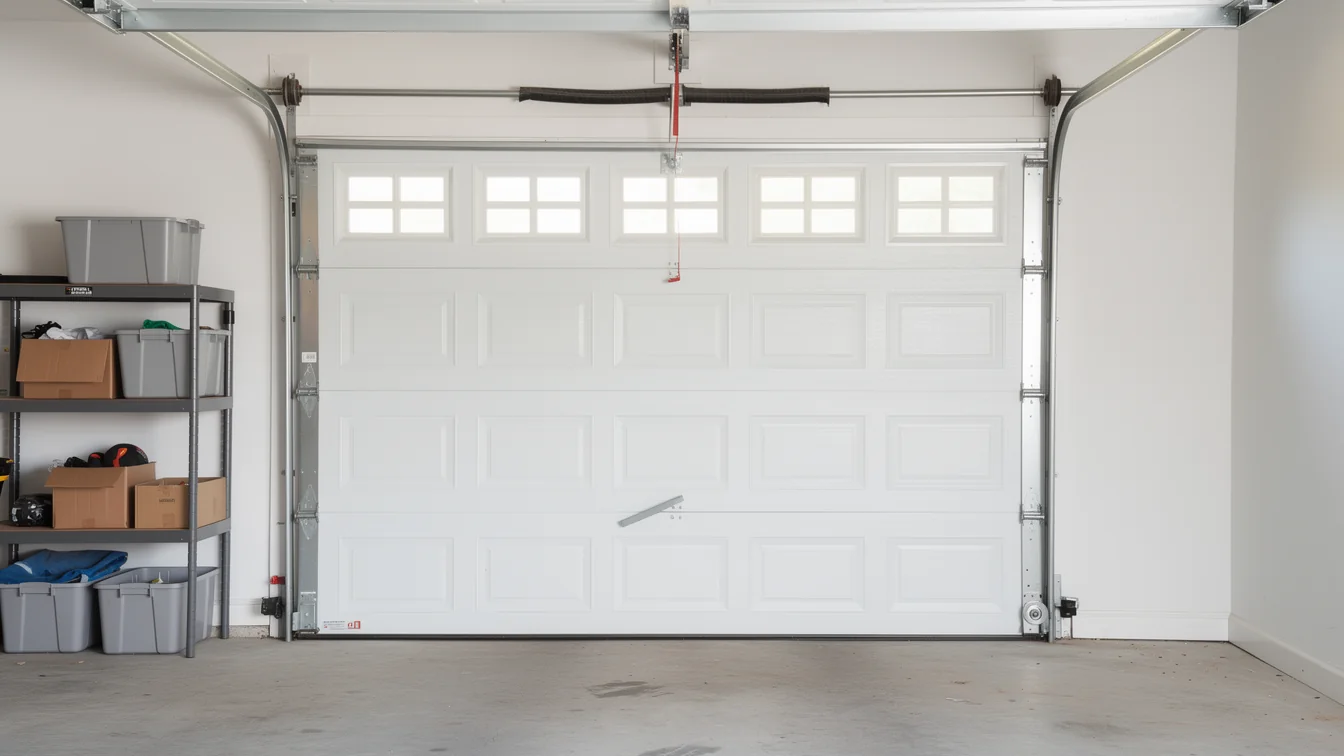
When a track goes out of alignment on a house this age, it's almost always one of two things. Either the vertical track has pulled away from the wall stud by a sixteenth of an inch where the bracket was never meant to flex that much, or the horizontal track has dropped on one side because the hanger wire or angle iron supporting it was fastened to framing that's since dried out and shrunk. On older two-car openings you'll often see it worse on one side than the other, because one jamb took more of the seasonal movement than its neighbor. Rollers that have gone fifty years without lubrication grind against a track edge that's no longer square, and that grinding wears a groove that makes the roller jump the next cold snap. None of this shows up as a sudden bang most of the time - it shows up as a door that sticks a little more each month until one morning it won't close square at all.
Doing Nothing For Now
A door that's slightly off track but still opening and closing isn't an emergency, and we won't tell you it is. If the door is sagging on one corner but still seats in the opening, you can usually run it for a few more weeks without the cables jumping the drum. What you shouldn't do is keep forcing it past a point where it binds and then releases with a jolt - that's how a roller finally leaves the track for good, usually on the coldest morning of the year when the steel is least forgiving. If you hear a new scraping sound or see daylight at the bottom corner that wasn't there before, that's the signal the movement has gone from cosmetic to structural, and waiting longer just adds wear to the opener motor that's now fighting a bent track on every cycle.
The Common Mistake
The mistake we see most often on houses from this era is someone reaching for a hammer and pliers and bending the track back into rough alignment themselves. It looks fixed. The door closes. But a track that's been bent once work-hardens at that spot, and it will go out of true again faster than it did the first time, usually within a season, because the bend concentrates stress instead of relieving it. The other version of the same mistake is replacing rollers without checking why they wore unevenly in the first place - on a house built in the 1960s or 70s, uneven roller wear is almost always telling you something about the track or the framing behind it, not the roller. Swap the part without checking the cause and you're back here next winter. We won't swap parts that aren't the actual problem just to close a ticket; sometimes the honest answer is realigning the track and leaving the rest alone.
Frequently asked questions
Why does my door only go off track in the winter?
Cold makes the framing and slab move more than they do in summer, and on houses from the 1960s-70s building era around Manchester, the track brackets were set for a house that's since shifted slightly with each freeze-thaw cycle. The track binds against that movement until a roller finally jumps.
Can I just bend the track back myself?
You can, but a track that's been bent once work-hardens at that point and tends to go out of alignment again faster than before. On older Manchester housing stock where the underlying cause is framing movement, bending the track treats the symptom, not the reason it moved.
Is a slightly crooked door safe to keep using?
If it still opens, closes, and seats square in the opening, you can usually keep using it short term. Stop and get it looked at if it starts grinding, jolting on release, or leaving a gap at one bottom corner - that's the point where cosmetic wear turns into a cable or roller failure.
Related garage door services in Manchester
More garage door guides
Book garage door service in Manchester
Call now or request a quote - tell us what the door is doing and where you are.